What to know before you go
In Bonifacio, visit the fortified upper town set on its white limestone cliffs (citadel, King of Aragon’s Stairway, marine cemetery), walk the cliff path towards the Pertusato lighthouse, then see the cliffs from the sea and swim at Piantarella or Petit Sperone. The town is 35 minutes from the house by car: one day is enough for the essentials.
Things to do in Bonifacio: the essentials
In Bonifacio, start with the fortified upper town, set on white limestone cliffs: the citadel, the King of Aragon’s Stairway cut into the rock, the marine cemetery and the Gouvernail. Add the cliff path towards the Pertusato lighthouse, a boat trip and a swim at Piantarella or Petit Sperone, in a municipality where the bathing water is rated excellent.
Bonifacio sits at the southern tip of Corsica, facing Sardinia. The municipality covers 138 km² and has 3,204 year-round residents. The town is on two levels: the upper town, inside its ramparts, and the Marina, the harbour, below.
- The citadel and the old town, on foot.
- The King of Aragon’s Stairway, 189 steps in the cliff.
- The marine cemetery and the Gouvernail, at the tip of the peninsula.
- The cliff path, from the Col Saint-Roch towards the Pertusato lighthouse.
- The Marina and a boat trip under the cliffs.
- The beaches: Piantarella, Petit Sperone, Maora.
Bonifacio from Porto-Vecchio: distance and route
From the house, in Porto-Vecchio, Bonifacio is 35 minutes by car, for 29 km via the T10, measured with no traffic. The harbour, where the boats leave from, is the same distance. In July and August, the road and the car parks are busier: set off early.
On the way, Rondinara beach is 30 minutes from the house: see our page Rondinara beach.
Parking in Bonifacio: car parks, prices and the free period
Space for cars is tight. The municipality opens five car parks in town and one at the entrance to visitors, about 885 spaces in all, some of them shared with permit holders. The other car parks are reserved for residents.
- When you pay: from the spring school holidays to the end of the All Saints’ holidays. The rest of the year, the municipal car parks are free.
- At the harbour: the short-stay car park (20 spaces, free for the first hour, then paid; card only, at the exit barrier), P1 (218 spaces) and P2 (131 spaces).
- On the way up to the upper town: P3 (66 spaces).
- At the far end of the upper town, near the cemetery: P5, the largest (300 spaces).
- At the entrance to the town, at the roundabout: the Valli car park (150 spaces), €10 a day, card only. In 2026, a free shuttle linked it to the Marina from 16 June to 11 September, from 10 am to 6 pm, every 30 minutes.
- Motorbikes: 100 free spaces, at the Marina and in the upper town.
- Avoid: the pay-and-display zones, meant for residents, with deliberately high rates.
The holiday-maker card (€60 for the first week, then less) is aimed at people staying in town. For a day trip from Porto-Vecchio, the Valli flat rate is enough.
Getting up to the upper town: on foot or by little train
- On foot, up the Montée Rastello: it starts at the Marina, at the foot of the church of Saint-Érasme; in the Middle Ages, it was the only way up to the citadel. At the Col Saint-Roch, a viewpoint looks over the Diu Grossu rock, known as the Grain de Sable. You enter through the Porte de Gênes, at the Bastion de l’Étendard.
- On foot, up the steps from the Quai Banda del Ferro: at the end of the harbour, they climb in stages to the Porte de France and the tourist office information desk, rue Fred Scamaroni.
- By little train: it leaves from behind the harbour master’s office, where the ticket desk is, and arrives at the Carotola, near the Place du Fondago. Keep your ticket for the return. Departures every 30 to 45 minutes, free for under-6s and for people with reduced mobility, payment in cash or by cheque. In 2026, it ran from April to the end of October.
- By car: up to P5, at the far end of the upper town.
The citadel and the old town
The upper town stands more than 60 metres above the sea. At the end of the 12th century, Bonifacio became the Genoese’s first ‘presidio’ in Corsica: a fortified town whose inhabitants defended it themselves. You visit it on foot, through narrow lanes that open onto small squares facing the sea, such as the Place Manichella.
From 15 June to 30 September, the historic centre is pedestrian in the evening, from 7 pm to midnight.
The Bastion de l’Étendard
Listed as a historic monument, the bastion is the emblem of the ramparts and overlooks the harbour. The visit starts on its esplanades, with views over the harbour, the cliffs and Sardinia; panels explain its role in defending the town. According to the tourist office, the citadel has never been taken since the 16th century. Children aged 7 to 11 get a free activity booklet.
The churches of Sainte-Marie-Majeure and Saint-Dominique
- Sainte-Marie-Majeure: begun by the Pisans in the 12th century and completed by the Genoese a century later. In the Middle Ages, notaries’ deeds were read out under its loggia, and the podestà, the town’s magistrate, dispensed justice there.
- Saint-Dominique: a Gothic church completed in the 14th century by the Dominicans. It holds the reliquary of Saint Bartholomew, which weighs more than 800 kg and is carried in procession on 24 August. In season, concerts of polyphonic singing are held there.
The marine cemetery
At the tip of the peninsula, the Saint-François marine cemetery lines up small family chapels facing the sea. It was created in 1823, away from the houses, for reasons of hygiene, then extended after the cholera epidemic of 1854. It is the southernmost cemetery in France. The tourist office suggests coming in the late afternoon, when the sun sinks over the cliffs.
The Gouvernail
Right next to the cemetery, the Gouvernail is a former military site: a tunnel of 168 steps goes down into the cliff to a chamber 10 metres above the sea. The army engineers built it in 1880 to watch over the strait, with a searchlight that lit the night as far as Sardinia. It takes its name from a rock shaped like a rudder (gouvernail) below.
- Opening: from April to October (1 April to 31 October announced for 2027); in July and August 2026, from 9 am to 7.30 pm.
- Payment: the tourist office listing only mentions cash and cheques.
- Access: not possible in a wheelchair.
The King of Aragon’s Stairway: 189 steps in the cliff
The stairway (Escalier du Roy d’Aragon), listed as a historic monument, has 189 uneven steps cut into the cliff. Legend says the King of Aragon’s troops dug it in a single night, in 1420. In fact, it led to the Saint-Barthélemy well, a freshwater spring now closed to the public. A letter from 1481 already mentions plans for an emergency stairway in the cliff, near the Torrione tower. At the bottom, a path cut into the rock runs along the sea, facing Sardinia.
- What to wear: flat, closed shoes are compulsory (no flip-flops, sliders or heels). A helmet is lent at the entrance.
- Who it suits: you need to be reasonably fit; not advised for people with heart conditions. No animals, baby carrier compulsory for under-3s, not accessible in a wheelchair.
- Prices shown in November 2026: from €5 for an adult and €2 for a child aged 6 to 11. Cards accepted.
- Winter opening: from 5 November 2026 to 14 March 2027, Monday to Saturday, 11 am to noon and 2 pm to 3 pm.
- Closures: during an orange weather warning, and sometimes in a severe heatwave. Check before you come.
- Booking: online on the tourist office website or at its information desks.
The Marina, Bonifacio harbour
The Marina forms a U at the end of the inlet. On one side, the fishermen’s house, where you can buy the local catch on some days; on the other, the ferry terminal, from which ferries reach Sardinia in just under an hour. In between: the harbour master’s office, the marina, the restaurants and the shops. The boats to the cliffs, the sea caves and the Lavezzi Islands leave from the quay.
From May to September, the quays of the Marina are reserved for pedestrians.
Walks in Bonifacio: cliffs, Pertusato, Strada Vecia
- The Campu Rumanilu path: an easy loop of about 3.5 km, 45 minutes to 1 h 30. It starts near the Saint-Roch chapel, at the entrance to the town: with your back to the upper town, take the paved path that climbs onto the cliff. You walk above the drop, with the citadel on one side and Sardinia in the distance. The tourist office suggests early morning or sunset, which are cooler in summer.
- Towards the Pertusato lighthouse: the Capu Pertusatu path extends the Campu Rumanilu towards the signal station and the lighthouse. The loop is just under 6 km, about 2 hours with 282 metres of ascent, along the edge of a cliff about a hundred metres high. You can swim on the way at Saint-Antoine beach.
- The Strada Vecia: a loop of about 10 km and 3 hours, easy to moderate, starting from the Marina. This Genoese track crosses the maquis, passes old lime kilns, reaches Paragan beach and approaches the Madonetta lighthouse, at the mouth of the inlet. There is no water point: bring a water bottle and a cap in summer.
- The Hermitage of the Trinité: from Paragan, a path climbs to this former hermitage, whose church dates back to the 9th century, with a view of Bonifacio.
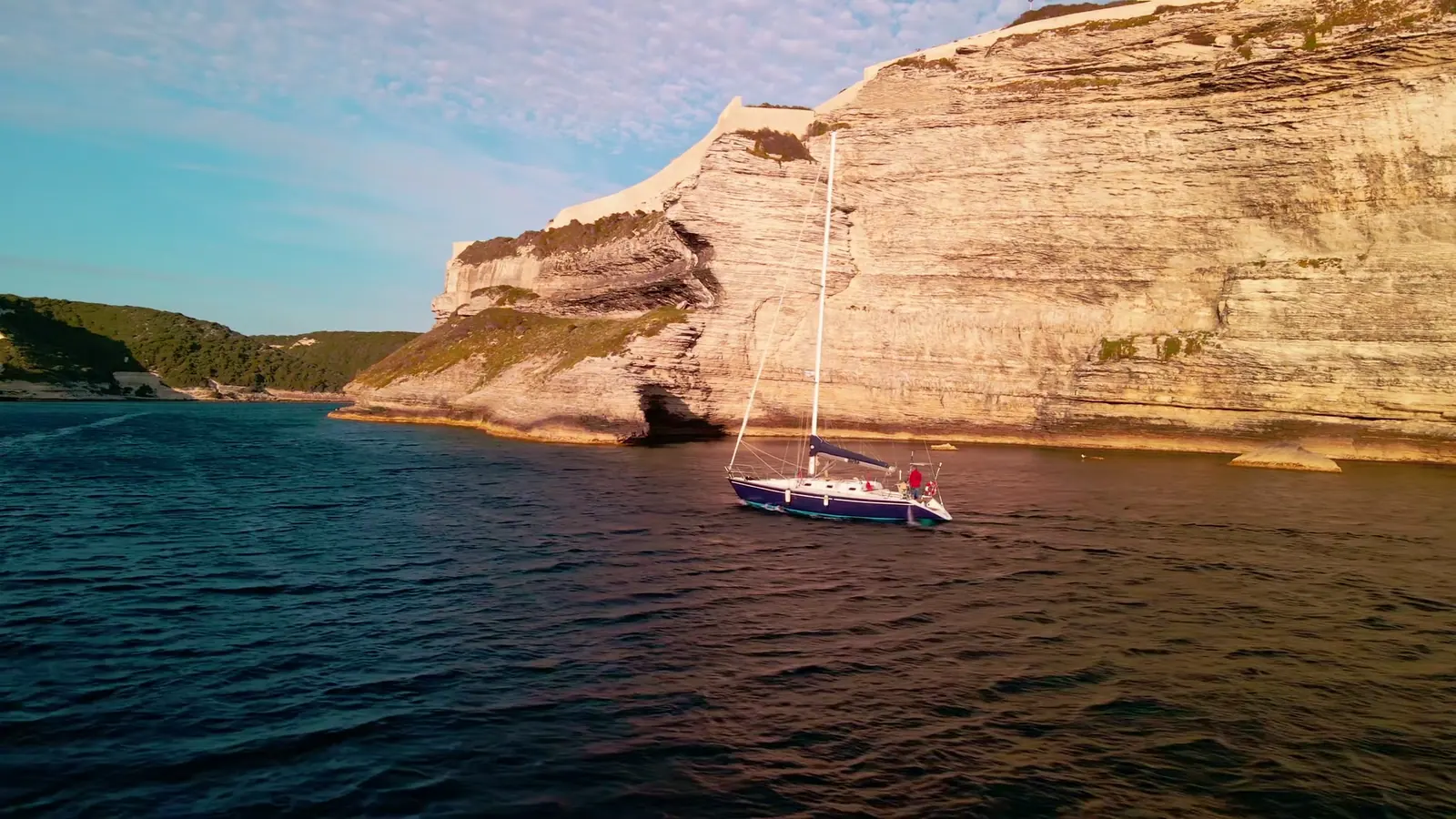
Keep well away from the edge: the limestone crumbles and the cliffs are dangerous. Fires, camping, bivouacking, litter and motor vehicles are forbidden. These cliffs are made of about a hundred metres of layers of marine sediment, laid down some twenty million years ago.
The Pertusato site is going to change: the municipality and the Conservatoire du littoral, the French coastal protection agency, plan to move part of the path inland, as it is threatened by rockfalls, and to give the lighthouse road back to walkers. According to the local press (July 2026), the work will not start before 2028.
More walks around the house: Hiking near Porto-Vecchio.
Beaches near Bonifacio
First, a fact you can check: in the municipality of Bonifacio, the health authorities monitor seven bathing points. According to the official French Ministry of Health website, all of them were rated excellent every year from 2022 to 2025. In 2026, each was tested seven times, between late May and early September. On 19 November 2026, the 2026 rating had only been published for Piantarella: excellent.
| Monitored bathing point | Rating 2022 to 2025 | 2026 tests |
|---|---|---|
| Piantarella | Excellent every year | 7 good out of 7 |
| Sant’Amanza beach (Gulf of Santa Manza) | Excellent every year | 6 good, 1 average (3 August) |
| Sant’Amanza north (Gulf of Santa Manza) | Excellent every year | 7 good out of 7 |
| Rondinara | Excellent every year | 7 good out of 7 |
| Tonnara | Excellent every year | 6 good, 1 average (1 July) |
| Balistra | Excellent every year | 6 good, 1 average (20 July) |
| Cala di Ciapili | Excellent every year | 7 good out of 7 |
Petit and Grand Sperone, Saint-Antoine and Paragan are not among the monitored points.
- Piantarella: 45 minutes from the house, east of Bonifacio, via the D260 then the Piantarella road. A small lagoon in the Bouches de Bonifacio nature reserve, for kitesurfing, wing foiling, kayaking and snorkelling. No white sand here: banks of Posidonia, a protected seagrass, wash up on the beach; they are a sign of good health and removing them is forbidden. The beach is small: come early in the morning or late in the day.
- Petit Sperone: a cove of fine sand facing the island of Piana. You reach it on foot from the end of Piantarella beach, along a path through the maquis (10 to 20 minutes). The path crosses uneven, slippery rocks: wear good shoes, and no pushchairs.
- Grand Sperone: next to Petit Sperone. Neither beach has Posidonia. Avoid them in an east wind: the fine sand blows everywhere. There are bins at Grand Sperone; elsewhere, take your rubbish home.
- Maora: a beach about 800 metres long at the head of the Gulf of Santa Manza, 35 minutes from the house. It is public, with a few private areas.
- Rondinara: in the municipality of Bonifacio, 30 minutes from the house: see our page Rondinara beach.
Bonifacio in one day
- Early morning: a 35-minute drive from Porto-Vecchio, then park at the Valli or at P5. From 15 July to 25 August, the tourist office advises visiting the upper town early in the morning or late in the day, especially early in the week.
- Morning: the upper town on foot: Bastion de l’Étendard, Sainte-Marie-Majeure, King of Aragon’s Stairway, then the Gouvernail.
- Midday: down to the Marina, on foot or by little train.
- Afternoon: a boat trip under the cliffs (about an hour, see Bonifacio boat trip) or a swim at Piantarella and Petit Sperone.
- Late in the day: the marine cemetery, then the esplanade of the Saint-François quarter or the Campu Rumanilu path for the sunset.
With a second day: the Lavezzi Islands, or the Pertusato loop.
Bonifacio with children
- King of Aragon’s Stairway: children who climb back up the 189 steps receive a certificate. Baby carrier compulsory for under-3s.
- Bastion de l’Étendard: a free activity booklet for 7- to 11-year-olds, with a reward at the end.
- Little train: free for under-6s; it saves the climb on foot.
- Paths and beaches: the Campu Rumanilu is easy, but the cliffs are dangerous; the Petit Sperone path is not suitable for pushchairs.
More ideas: Corsica with kids.
Where to watch the sunset in Bonifacio
- The esplanade of the Saint-François quarter, near the marine cemetery: the cliffs turn orange and pink.
- The marine cemetery, in the late afternoon; the tourist office recommends it especially in autumn.
- The Campu Rumanilu path, quieter at that time of day.
By boat: cliffs, sea caves, Lavezzi and Sardinia
The cliffs are best seen from the sea: the classic trip from the harbour lasts about an hour and passes the King of Aragon’s Stairway and the sea caves. The Lavezzi Islands, in the Bouches de Bonifacio nature reserve, can only be reached by boat. Durations, choices and tips: Bonifacio boat trip and Lavezzi Islands. Ferries to Sardinia leave from the ferry terminal: Sardinia from Bonifacio.
Useful questions
What can you do in Bonifacio in one day?
In the morning, the upper town on foot: Bastion de l'Étendard, King of Aragon's Stairway, Gouvernail. In the afternoon, a boat trip under the cliffs or a swim at Piantarella and Petit Sperone. Late in the day, the marine cemetery and the Saint-François esplanade for the sunset.
Where can you park in Bonifacio, and is it free?
The municipal car parks charge from the spring school holidays to the end of the All Saints' holidays, and are free the rest of the year. In season, the Valli car park, at the entrance to the town, costs €10 a day; in 2026, a free shuttle linked it to the Marina from 16 June to 11 September.
How long does it take to get to Bonifacio from Porto-Vecchio?
35 minutes by car from the house, for 29 km via the T10, measured with no traffic. From the same house, the beaches of Santa Giulia and Palombaggia are 15 and 20 minutes away.
How many steps does the King of Aragon's Stairway have?
189 uneven steps, cut into the cliff. Flat, closed shoes are compulsory, and a helmet is lent at the entrance. Prices shown in November 2026: from €5 for an adult and €2 for a child aged 6 to 11.
Is the water at the Bonifacio beaches clean?
Yes. The seven bathing points monitored by the health authorities in the municipality, including Piantarella and Rondinara, were rated excellent every year from 2022 to 2025, according to the French Ministry of Health website.
What can you do in Bonifacio with children?
Children who climb back up the 189 steps of the King of Aragon's Stairway receive a certificate. At the Bastion de l'Étendard, 7- to 11-year-olds get a free activity booklet. The little train between the Marina and the upper town is free for under-6s.